ATARI ST NEWS
Article June 1991

Marc Marc - MarcMarc MD artist

By Drs C.L.F. Reniers

It is well known that the Atari ST is an ideal computer for drawing. There is an abundance of drawing programs available for the creative Atari ST user. But is the Atari ST also used by artists to create art? What would artists, who have the reputation of being romantics and floating somewhat above the ground, want with computers? The editorial staff of Atari ST News came into contact with two artists who create art using the Atari ST. What is unusual here is that both work with software they write themselves. In this article we take a look at how this is done.

Marc Marc - MarcMarc MD artist - graphic fa9106d0Marc Marc - MarcMarc MD artist - graphic fa0290a1

Marc Marc - MarcMarc MD artist - graphic fa9101a4Marc Marc - MarcMarc MD artist - graphic fa9009e0

(Marc Marc)

Art
The Amsterdam artists Marc Marc and Benten van Schie are often found behind their Atari ST while working on their art. What is striking is that for a large part of the time no trace of art can be seen on the screen. Instead of art, there are codes and numbers on the screen. Is art being made here or is this work on a programming text? 'Both!' is the first answer I receive. This is followed by a stream of words in terminology that I do not fully understand. Both are skilled in programming the Atari ST, which is an unusual phenomenon for artists.


Auto-Composer
Marc Marc is working on a so-called 'Auto-Composer'. This is a program into which he has placed a portion of creative capability, which already 'self-composes' artworks and possesses an infinite number of variations.
Moving Paintings
Benten van Schie creates 'Moving Paintings' in which the shapes and lines are drawn by her software. The artwork that is created on the screen moves continuously while it is being composed. These are motion cycles that have neither beginning nor end.
Artificial Creativity
What both are doing does have something to do with artificial intelligence. They are engaged in a complex matter, namely attempting to automate the creation of art, as it were. That many problems arise in this process is of course not surprising when one considers that in the making of art non-rational processes play a role, which we conveniently call creativity. How do you approach something like that?
Derivative
Marc Marc: 'It is not possible to define a creative process unambiguously without resorting to abstract terms. However, the product that results from a creative process can be examined afterwards, and that provides a foothold to arrive at a kind of derivative that can be used for processing with the computer.'
Empirical
Benten van Schie: 'By means of empirical methods, results can be achieved that are difficult to theorize, and the handling of computer language itself is already a creative process, which makes it even more difficult to express this clearly in words.' Nicely said, I thought, but it did not make me much wiser.
Looking
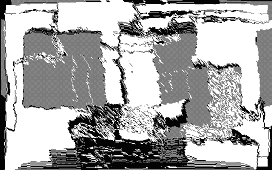
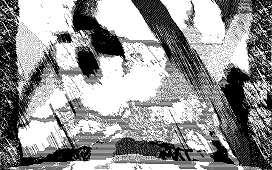
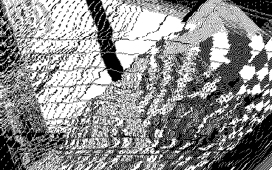
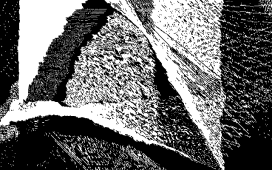
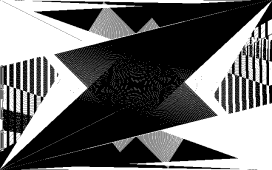
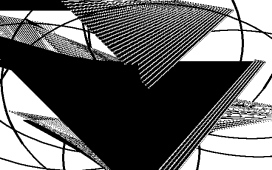
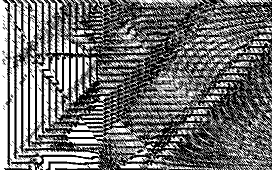
I had to look. Look a lot. That is what they themselves do as well, they said, and that is also the advice they give to the readers of Atari ST News. The eight artworks printed here give an impression of what the artists produce with their programming work, and they ultimately consider this more important than the software itself.
Original
I am deeply impressed by what I have seen on the screens. I had never seen this kind of work before on the screen of the Atari ST, and it is clear that they have developed a considerable number of 'tricks' to achieve the suggestion of artificial creativity.

Geheim
Perhaps that is why they are somewhat secretive about the how and why of that artificial aspect. After all, it is largely suggestion, because the software is of course not really capable of producing something entirely on its own. Marc and Benten say that there are clever elements within the software and that certain things belong to the golden discoveries made during the extensive research. However, observation and contemplation are indispensable in developing the routines and are also of the utmost importance when it comes to choosing the moments at which the program is stopped in order to capture the images as they appear, such as those shown on these pages.
Atari ST
Both work on a not recent type of Atari ST, but they are content with that for the time being. Although they have developed various things in color, what they present of their art to the outside world is in black and white. Many hours of looking at a programming text can also be very tiring on a color monitor. Therefore working on a black-and-white screen has its advantages in that respect as well.

Benten - graphic sjorre1Marc Marc - MarcMarc MD artist - graphic ll_3c.gif

Marc Marc - MarcMarc MD artist - graphic at_st3Benten - graphic hhohx00

(Benten van Schie)

USSR
Marc Marc held an exhibition at the end of last year featuring a series of paintings and his Auto-Composer at the Central House of Artists in Moscow, a museum for modern art. The three Atari ST's he needed for the presentation were loaned to him by the Atari computer club in Moscow. Marc says that he enjoyed giving such a presentation in a country where computers were not yet an everyday phenomenon.
Netherlands
Presentations are also scheduled in the Netherlands. At this moment discussions are taking place with Atari Benelux about sponsoring equipment for an exhibition at the Canon Image Centre in Amsterdam. From September 5 onward, an installation of Marc's Auto-Composer will be on display. Benten also has exhibition plans with her computer art, but at this moment she cannot yet reveal details due to ongoing negotiations. Atari is not known as a company that actively engages with its user community. If I am to rely on Marc's accounts, this is slowly beginning to change. That Atari is going to become very busy seems certain to him. How did these artists actually come to involve themselves with computer art?
Benten van Schie
Years ago she once saw a presentation where drawing was done via computer on a large screen, and she knew that she also wanted a computer to work with. Much later (by then the Atari ST had already been released), she was able to borrow a computer and began working with the drawing program she had purchased. The Atari ST she borrowed also included several programming languages. Her curiosity led her on a journey of discovery with the examples that were supplied. Without fully understanding what everything meant, she changed numbers in the listings of the example programs. This resulted in many surprising outcomes. Through this, her interest in programming was permanently awakened and ideas began to flow. She started to deepen her knowledge of programming in order to give form to her graphical ideas. Learning to program was not accomplished in just a few days, but the results were encouraging enough to remain motivated. While stumbling over programming problems, her so-called moving paintings emerged. Benten also noticed that some programming errors led to interesting results that were later deliberately used.
Marc Marc
He was once given the opportunity to draw on an Apple Macintosh and saw possibilities in that. It was not until the arrival of the Atari ST that he decided to purchase such a computer. Initially he had no intention of programming himself, but when drawing with the usual drawing programs could not provide what he was looking for, he nevertheless began programming. He had hoped that his electronics experience would be useful, but that proved disappointing. However, once he had found a method to lay out programming instructions visually (similar to electronic schematics), he progressed quickly. Many of his ideas were derived from experiences with electronic music, which he specifically directed toward the visual domain. By training Marc Marc is a painter, and this is clearly visible in his computer art. He says that in his computer art he aims to achieve a similar expressive power as in his abstract paintings. What especially intrigues him is the fact that this must be approached in a very different way when working with a computer.
PD disk ACN 1000
For the cover disk of this issue both artists contributed material contained in the folder named 'TARTARTA' on this diskette. Benten provides with her MIRAKELS art-creation program a portion of her creativity. It is a kind of drawing program with which remarkable drawing surprises are conjured onto the screen. By pressing a specific key on the keyboard, a selection is made from one of the many functions that allow the user to start creating with the mouse. Marc Marc provided under the name ART MODERNE a program that contains 22 self-composing artworks. It is truly fascinating to observe how these artworks come into being. The program is an adapted version of his Auto-Composer with which the four works shown here were also created. Both programs are worthwhile to examine and use, because they demonstrate that very beautiful and original artistic creations can be made with these graphical programs. According to the artists, this is only the beginning of what is yet to come. That certainly promises much.
Postscript Marc Marc
The final part of the article dealt with placing orders for graphics at ACN and has been omitted because it is no longer relevant.

Back to Art Moderne Index     Back to MAIN Index

For response, write to marcmarc@xs4all.nl

This page & contents is Copyrighted (C)1996 by Marc Marc Amsterdam