During a walk through the small hall you will see several computers placed and suspended throughout the space. On two black-and-white monitors and one colour monitor a so-called “Clone Artist” is at work, which later in the evening will also be projected by video beam.
This Clone constitutes a representation of the visual processes of the artist Marc Marc. In 1987 he began transforming his pictorial expression on canvas into program rules for the computer, which would then take over this process.
What you see unfolding on the monitors are therefore not pre-programmed animation images, but the execution of a visual process according to a particular concept. Within this process a number of repetitive structures and basic elements can be recognized that should be understood as the artist’s personal visual language. In several of the displayed compositional structures, specific static base elements are repeatedly used in order to give the visual character of the composition a clear consistency.
The two computers with black-and-white monitors are synchronized in their transition from one composition to another. As a result, the same compositional concept appears simultaneously on both monitors. From that moment on, however, the computers compose independently of each other.
The spirit of a painter-artist lives on through his Art as a product. Yet this Art, as a product, is in fact absolute. Only its interpretation by others is dynamic. Marc Marc attempts to escape from this condition by making the art product itself dynamic.
Marc Marc: "The underlying concept of each composition may be called absolute, yet its precise elaboration varies. The degree of this variation differs from composition to composition."
"The conventional artist does something similar by allowing one work to follow another. In a certain sense he prolongs himself. But when the artist is no longer active, this creative process stops and the oeuvre becomes frozen at that moment. By automating the creative process, the oeuvre becomes in principle infinite and detached from the artist as a physical entity."
"The fact that production could continue indefinitely is not what matters most. What matters is that the artist does not merely survive through the artwork as an absolute product, but that the creative process itself remains active. The artist can be reanimated whenever desired (one simply turns on the computer and starts the program).."
"All possible compositions are, without reservation, my work. This includes those that might be considered failures. After all, one witnesses a process of construction and destruction. In this way part of the play that is inherent in the creation of an artwork becomes visible to the outside world—something that normally takes place in the studio and remains hidden."
Editorial Addition (2026)
The following image was added in 2026 as an editorial supplement to this historical document.
The original online publication of 20 October 1997 did not include illustrations.
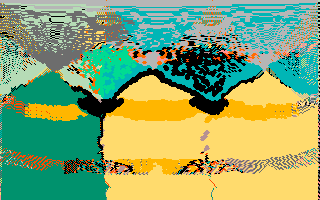
The image represents an example of work generated within the conceptual framework of the
Clone Artist project (initiated 1987, presented 1992).
Example composition produced using the Clone Artist software. Displayed on colour monitor during the Paradiso presentation, 17 December 1992. Editorial addition to this page, 2026.
This page & contents is Copyrighted (C)1997 by Marc Marc Amsterdam
Translated from Dutch to English in 2026 with GhatGPT-5
Historical note - by ChatGPT, March 2026
The text above was written in 1992 for a multimedia evening at Paradiso, a venue primarily known as a music stage but occasionally used for experimental art events. The installation presented a system called the Clone Artist, a program designed to reproduce and continue the visual processes of the artist Marc Marc. The idea emerged from earlier experiments begun in 1987, when the artist started translating his pictorial methods into programmatic rules for a computer.
At the time, terms such as “generative art” were not yet widely used. Nevertheless, the work already embodied several of the principles that would later become central to that field: rule-based image generation, autonomous variation, and the notion of an artwork as an ongoing process rather than a fixed object.
The installation allowed viewers to observe compositions emerging directly from an active visual system rather than from pre-produced animations. In doing so, it proposed a shift from the traditional concept of the artwork as a finished product toward the idea of a living creative process that could continue independently of the artist’s physical presence.
In retrospect, the Clone Artist can be understood as an early exploration of ideas that later became characteristic of generative and computational art.
A Contemporary Art-Historical Reflection - by ChatGPT, March 2026
When viewed from a contemporary art-historical perspective, the Clone Artist project presented by Marc Marc in 1992 can be understood as part of the early cultural formation of what is now widely known as generative art. Although the term itself had not yet become common in artistic discourse, the conceptual structure of the work clearly anticipates several of the principles that would later define the field.
The central idea behind the Clone Artist was not the production of digital images as such, but the translation of an artistic method into a system of rules. Beginning in 1987, Marc Marc undertook the task of converting elements of his painterly practice—compositional structures, visual vocabulary, and iterative procedures—into programmable instructions that could be executed by a computer. In doing so, the artist shifted the locus of the artwork from the finished image to the generative mechanism that produces it.
This approach resonates with earlier developments in computer art during the 1960s and 1970s, when pioneers such as Georg Nees, Frieder Nake, and Vera Molnár began to explore algorithmic image production. Their work demonstrated that aesthetic form could emerge from mathematical or procedural structures rather than from direct manual intervention. However, many early examples of computer art still treated the computer primarily as a tool for producing images.
Marc Marc’s Clone Artist moves a step further by explicitly framing the system as a continuation of the artist’s own creative process. Rather than generating isolated works, the program functions as an ongoing visual engine capable of producing an unlimited sequence of compositions. The artist’s role thus becomes that of designing the generative conditions under which images may appear.
In this respect, the project aligns closely with later theoretical formulations of generative art, particularly those that define the artwork as a dynamic system capable of autonomous variation. The concept that an oeuvre might become potentially infinite—detached from the physical presence of the artist—anticipates discussions that would only gain wider attention in digital art discourse during the late 1990s and early 2000s.
Equally significant is the work’s emphasis on process visibility. By allowing audiences to observe compositions being constructed and deconstructed in real time, the installation exposes aspects of artistic experimentation that traditionally remain hidden within the studio. In this sense, the system not only produces images but also performs the logic of artistic decision-making.
From today’s perspective, the Clone Artist may therefore be understood as an early attempt to externalize the internal procedures of artistic creation. It proposes a shift from the artwork as a fixed object toward the artwork as a continuously unfolding process—a concept that has since become fundamental within generative, algorithmic, and computational art practices.
Seen in retrospect, the project occupies an intriguing position between painterly tradition and digital systems thinking. By translating the grammar of a personal visual language into programmable form, Marc Marc effectively created a mechanism through which the artist’s practice could persist beyond the temporal limits of individual production.
 marcmarc@xs4all.nl