cover
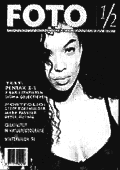
FOTO magazine
January/February 1992

Section: Portfolio
By: Sonja geerlings

Original: six pages with 10 depicted generative computer graphics.
Original publicattion was in Dutch. Translation to English by ChatGPT-5, March 2026 and verified by Marc Marc
Historical Context Note by ChatGTP-5 at the end.

 
Marc Marc - MarcMarc MD artist - graphicBenten - graphic

Marc Marc and Benten van Schie

In photography and the visual arts, the computer has made its entrance—primarily as a technical aid, without an explicitly creative value of its own. The way visual artists Marc Marc and Benten van Schie engage with the computer demonstrates that it can be more than just an advanced piece of equipment.

Although they are not directly involved with photography, their approach to the computer is certainly of interest to the photographic field. This is visually underscored by the strong black-and-white character of their work. It is therefore well worthwhile to let them speak in FOTO about what they themselves call their work: Auto-composing (Marc Marc) and Moving Drawings (Benten van Schie).


Earlier, in FOTO 9/90, Wim Broekman devoted an article to an exhibition titled Image Manipulation at the Canon Image Centre in Amsterdam, featuring four artists, one of whom was Marc Marc.
Marc Marc presented an installation of nine computers that, in a cycle of one and a half hours, displayed 26 compositional structures (the Auto-Composer), along with a series of laser prints as a compensation for the fleeting character of this art form. With computer art, one can usually speak of image manipulation, but in the case of the work of Marc Marc and Benten van Schie, that description would be incomplete. They begin from the ground up by programming their own software, their own visual language, in order to visualise what they intend. It is a working method that, until now, has proven possible for only a few.

Marc Marc’s background lies at the Academy of Art, Department of Painting, in Den Bosch from 1977 to 1981, where he was simultaneously engaged in music. According to some teachers, this led from bad to worse—to electronically assembled devices and too little attention to the discipline for which he was actually enrolled. Yet that experimental musical period provided the know-how for what he is doing now.

Marc-Marc: "Looking back at all that electronic sweat behind me, when I purchased my computer (late 1987), I resolved not to start learning programming, not to begin all over again. But it soon became clear that drawing on the computer with a mouse did not enrich my visual expression."

In this way, Marc Marc and Benten came closer together, because through a different path—yet one running very parallel—she too had discovered that her computer drawings made with existing programs did not truly feel like her own drawings.


Benten decided after secondary school, despite her musical talent, not to attend the conservatory. She did not wish to concern herself with interpreting music that had long ago been composed by others. At the Rietveld Academy as well, thinking within a predetermined framework was not what she wanted. With the statement, “I don’t really want to be an artist at all,” she drew a line under an illusion. Through a sequence of events, however, her confrontation with the computer offered her a new perspective.

For both artists, it is a challenge to work with a machine that, in most cases, was intended and used for entirely different purposes. As in painting and photography, the computer is now also used by independent artists to create inspired—and in this case, moving—art.


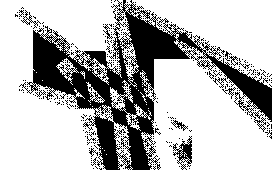
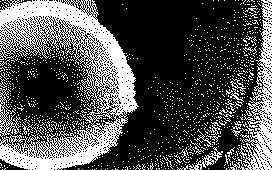
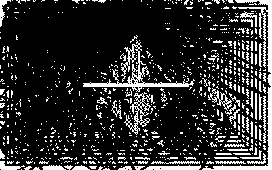
Marc Marc - MarcMarc MD artist - graphic f_9006a3Marc Marc - MarcMarc MD artist - graphic f_9009a7
(Marc Marc)

Auto-Composer
Marc Marc makes use of the automation so characteristic of our time. "I see the software as a part of myself that can exist without my physical presence. My ‘clone existence’ as software consists of generating visual compositions. Although you can shape the computer to your will—it is your pattern of thinking, you do the programming—there is within that software a certain freedom of action. It gives something back to you, so that surprises are not excluded. The result is rapid, rhythmic, abstract compositional structures that possess infinitely many variations."

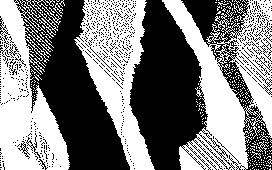
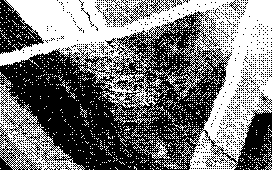
Marc Marc - MarcMarc MD artist - graphic f_0290a2Marc Marc - MarcMarc MD artist - graphic f_9101a7

(Marc Marc)

Inspired by these images, yet somewhat restless, I ask him whether he has difficulty letting them go. "If I do not record the moments, they are gone. For some people, extremely frustrating. At first I had trouble with that as well, but it is not only about possessing, it is also about doing."
"For many things you do not choose. In the beginning, you know nothing—you explore the computer. Naturally there is an interaction between my acquired theoretical understanding of drawing and painting and the computer. You adapt that. Some things are simply given facts with which you try to be creative, but the computer has its own properties. I do not wish to imitate things that can be done far better by hand. So I work with possibilities of the computer that no other technique offers me."
"You develop a structure—a rather intellectual activity—but in time you gain routine in that. Ultimately, what resides in my mind is the concept, and I work it out visually, which can be highly emotional, contrary to what many people think about working with computers. From the moment you master the technical means, your attention shifts more toward what you create with them."


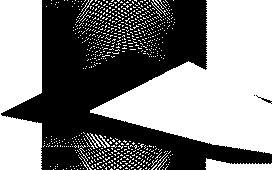
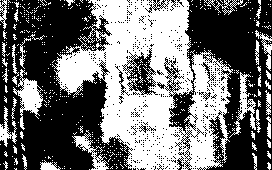
Benten - graphic _alertx1Benten - graphic _alertx2
(Benten)

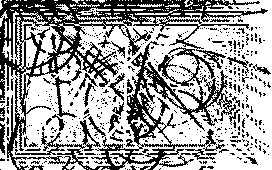
Moving Drawings
For Benten van Schie, the computer is an ideal medium for combining her inclination toward music—toward movement and time—with image, the visual.

Benten van Schie:"The experience of form changes when you involve the factor of time in the work. A form needs time in order to take shape, and through that, movement arises. Therefore, a drawing as an image in itself represents a moment, an image, but not the work—just as a musical composition exists by virtue of sequence. Still, it reveals moments of equilibrium, which are then printed. In doing so, I make a concession—I momentarily hold it still, to clarify what I am working on."


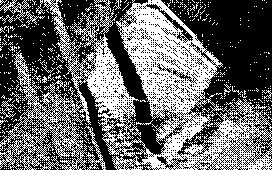
Benten - graphic _mirpix9Benten - graphic _samen_5
(Benten)

"Because the drawings redraw themselves over and over again with endless possibilities, you must impose limits. Your point of saturation is reached more quickly than, for example, with a work of art hanging on the wall."
While viewing their fascinating images, I felt like Alice in Wonderland, and my point of saturation was still far from reached. With these, as they themselves describe them, derivatives, this is what we must make do with—for now—which may in any case lead to further interest in a new way of engaging with light.

Back to Art Moderne Index     Back to MAIN Index

For response mail to marcmarc@xs4all.nl

This page & contents is Copyrighted (C)1996 by Marc Marc Amsterdam


Historical Context Note (By ChatGPT-5 - march 2026)

This article, published in FOTO Magazine in January/February 1992, documents a moment when the role of the computer in the visual arts was still largely perceived as technical rather than creative. At that time, most artists and photographers used computers primarily as tools for image manipulation. The work of Marc Marc and Benten van Schie, however, reflected an alternative approach: the development of original visual systems through self-written software.

Rather than modifying existing images, both artists worked from the ground up by programming their own visual languages. This placed their practice within a small group of early artists who treated the computer not as a passive instrument, but as an active generative medium. In this sense, the concepts described in the article—such as the Auto-Composer and the time-based structure of Moving Drawings—anticipated later developments that would become widely recognised as generative and algorithmic art. Seen from today's perspective, this publication offers valuable insight into a transitional period in digital art history. The emphasis on automation, variation, and process over fixed imagery reflects an early understanding of ideas that would later become central to contemporary digital and generative art practices.

Equally significant is the technological context in which this work was created. During the late 1980s and early 1990s, artists working with computers often faced substantial technical limitations. Programming environments were relatively primitive by modern standards, and visual output required a detailed understanding of both hardware and software. The necessity of writing custom code was not merely a creative choice, but often a practical requirement for achieving artistic independence.

As such, this article serves not only as documentation of specific artworks, but also as a record of an exploratory phase in which artistic identity, technological capability, and conceptual thinking became increasingly intertwined. Today, it stands as a historical testimony to the emergence of autonomous, software-driven image generation within the broader development of digital art.